In this series, “Connecting to:”, I am examining each of the major arcana in depth. The major arcana are the most powerful and impactful cards of the tarot deck. Through a rich symbology, these twenty-two cards share with us the mysteries and secrets that are universal to the human experience and to spiritual evolution.
Each of these posts is a combination of a couple things: Intuitive notes I took while meditating with the card, comparisons of my notes to the traditional meanings of the card, and any other research or tidbit of information I find interesting/relevant! Think of these posts as little bulletin boards, with post-its from different sources and thought bubbles stuck all over. I may add to them from time to time, as well.
The Hierophant — V — Major Arcana
The keywords:
- surrender
- devotion
- higher power
- prayer
- blessings
- “let go and let god”
- humility
- purity of heart
- clarity
The meditation notes:
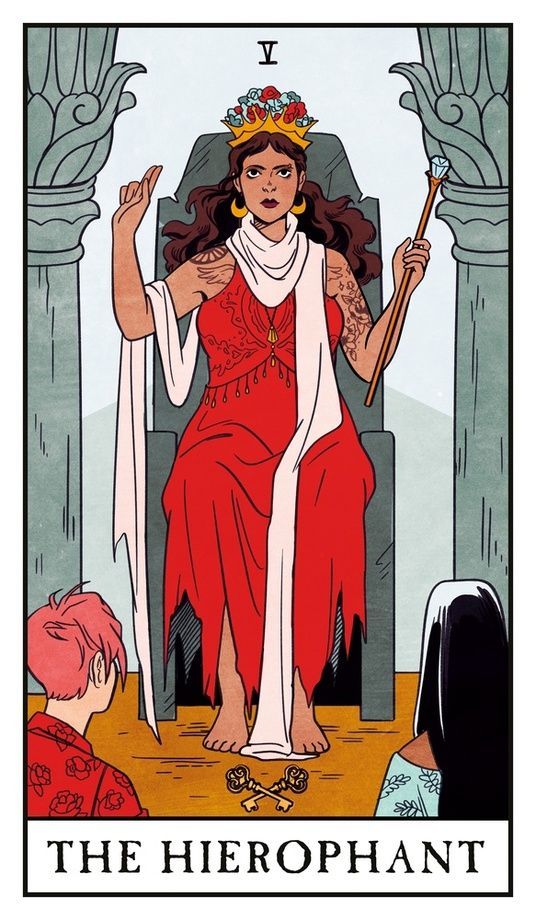
The first thing I notice about the central figure of this card is her stern expression: She really means business. She sits on a stone throne, much like The Emperor. However, this throne is not at all ornate like The Emperor’s is. There are no carvings, no detailed design to it — this throne is simple, designed for function over form. There’s the implication of beholding something ancient before us: no frills, just a deep and simple truth. She also sits between two stone pillars. It feels like there is a lot of rigidity in this card. There isn’t room for personal interpretation; it’s lacking a certain kind of flexibility.
She wears earrings in the shape of the moon, indicating to me that she is very connected to emotions and maybe even mothers. There are new moon vibes here, as if her purpose is to bring in new intentions. This is the start of something. Focusing even more on her physical expression, her dress is beaded, and it has designs on the bosom. She is adorned with tattoos. Her stone throne is super simple, and she herself is the actual decoration. The blessing, even. She is adorned in a huge, flowing, white scarf. It’s draped around and across her in a way that reminds me of the trees I draped at my wedding. For me, this is a clue that she (like a tree) is a being who is both ancient and knowledgeable.
Her hair is down and flowing all around her. It’s the most soft and flowing symbol in the card, aside from her scarf. I find this so interesting for several reasons: [1] I will never forget that, according to my senior year poetry class, the hair represents the feminine mystique (hehe). [2] In the vein of Mean Girls — the hair holds secrets. [3] I think about how cutting hair represents killing off bad energy (like how people cut it after breakups), and [4] I also think about how dreadlocks are seen as spiritual antennas. Hair holds energy, and it has a memory. Our goddess’ hair is long and flowing — meaning it has a long and detailed memory that lends to her powerful and knowing vibes.
She is barefoot, and the bottom of her dress is tattered. These details, plus the flowers she wears in her crown, give her a sort of natural indigenous vibe. Earthy and grounded. She is a priestess, or perhaps a goddess to be worshipped. At her feet, there are two skeleton keys, crossed over each other. It feels like she is the guardian of the keys to what you need — rather; what the people who seek her need. She has two people kneeling before her, reinforcing the idea that she’s a priestess or a goddess. With all of the stone present in this card, I feel like if you follow her rules and worship her, she will bless you. She is fair and impartial.
She holds a wand — but this is different than any of the other wands I’ve seen in the deck. It’s topped by a diamond, which I feel indicates some deep digging (like mining) that was done in order to access its power and wield its light.
The figures in this card are high up in a temple, as evidenced by the background being nothing but sky and the shadows of a mountain. This feels related to swords energy, to the element of air. This, plus her earthy vibes, give me the sense that the powers of this goddess will bring a mental clarity and a certain level of grounding to those who seek her.
The reading insights:
This chapter of Meditations on the Tarot gave me a greater understanding of the spiritual purpose of prayer and of how blessings come to be. The beginning of this chapter introduces the concept of vertical respiration, which is the steady pace of breathing in (prayer) and breathing out (blessings). It confirmed for me that meditation, the art of breathing through that which weighs us down, is in itself a form of prayer.
Jessica Dore’s chapter on The Hierophant in Tarot for Change actually makes mention of Meditations on the Tarot, which I love since these are my two favorite texts to pull from when I’m studying. Dore homes in on this idea of vertical respiration:
“Spiritual practice, by this understanding, is engaging in two-way conversation with a Higher Power. You say a prayer and you wait for the response. You breathe out and then in…When we open the lines of communication between the self and something greater, we position ourselves to recall that we have a voice in things, but never the final say.”
Tarot for Change, p. 55-56
It’s in this way that surrender to a higher power is actually freeing. There is an understanding of the hierarchy of spirituality, and as humans, we are not anywhere near the top of that hierarchy. I feel risqué saying this, lol, but this actually made me think of the kink world and BDSM (😂). For many, the act of submission is actually about having the personal authority to set your own parameters and speak them out loud (prayer) and then to receive pleasure fully from surrendering to the act (blessing). This quote from Meditations on the Tarot reinforces my thoughts here:
“True obedience is the very opposite of tyranny and slavery, since its root is the love which issues from faith and confidence. That which is above serves that which is below and that which is below obeys that which is above.”
Meditations on the Tarot, p. 112
The last concept that I thought was big enough to mention here because it helps to shape my understanding of The Hierophant is that of chastity, or being pure of heart. The Hierophant was the fifth card in the major arcana, so there was much discussion in this chapter about the pentagram. Without getting too far deep into the esoteric black hole of knowledge, the pentagram represents human will presiding over the four elements. Therefore, those who wish to practice magic must do so with a pure heart. In other words, their prayers must be for the good of all and not just for their own self-gain and satisfaction.
“The vow of chastity means to say putting into practice of the resolution to live according to solar law, without covetousness and without indifference…That which lives at the foundation of the heart is neither boring nor disgusting. The foundation of the heart is love. The heart lives only when it loves.”
Meditations on the Tarot, p. 113
If we as magical practitioners forget to approach our work with the respect, love and gravity necessary — we run the risk of veering off into black magic, a perversion of our divine gifts.
The takeaway:
As someone who does not subscribe to an organized religion, writing this blog post really helped me to get over some of my hang-ups with The Hierophant. Many of us feel uncomfortable with the ways that, throughout history, men have used the church in order to commit atrocities against humanity. It’s also true that many people who are open to tarot and other forms of so-called “New Age Spirituality” have divested from their churches of origin for a reason.
I’m happy, then, that I did my research and can see how The Hierophant is representative of a timeless spiritual truth rather than the dogma of organized religion. I appreciate the representation of The Hierophant in this deck, which gives us an indigenous interpretation of a pope-like figure. It’s giving a decolonized lens, quite honestly. And through this lens, I’m able to actually absorb the lessons of devotion, of surrender and of chastity.
As is the magic of tarot, what I learned through this practice was in accordance with what I was learning in other areas of my life. I did most of my research on this blog post while I was taking a psychic development course, and during the week we discussed the importance of ancestors altars — the subject of devotion came up.
The Hierophant, above all else, comes up as a reminder to tap into the ancient knowledge of our ancestors. To believe in magic and powers higher than us, and to surrender to them with a pureness of heart. With prayer, comes benediction.
 theburiedgold