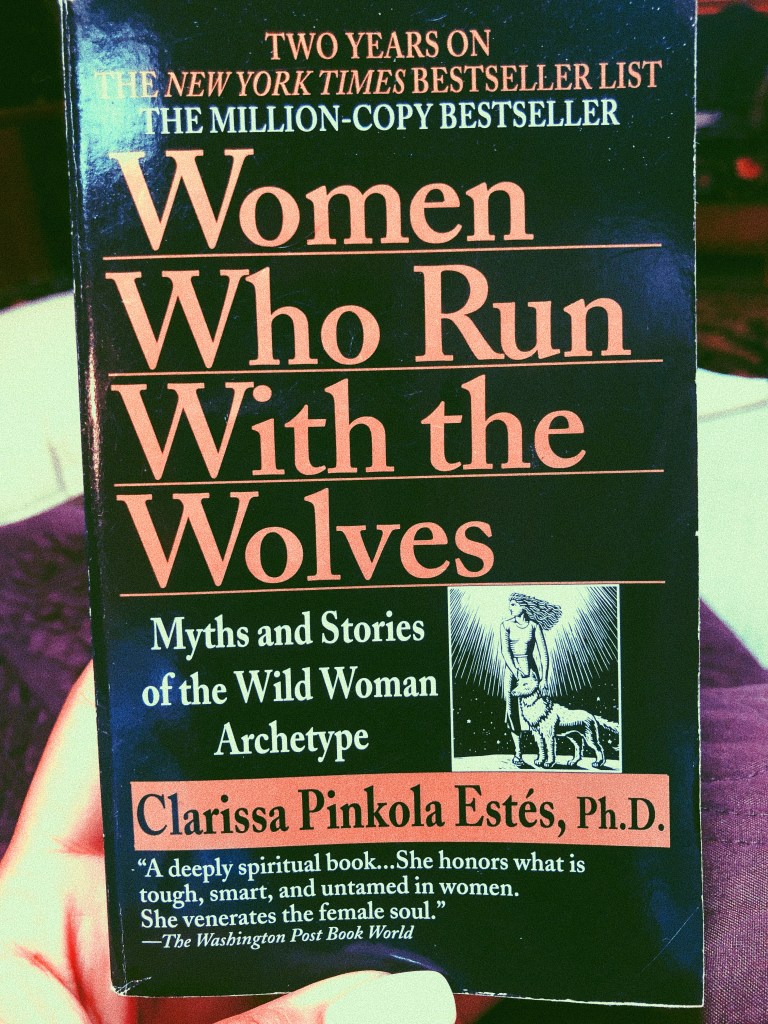
I want to discuss a book I’ve been reading called “Women Who Run With the Wolves: Myths and Stories of the Wild Woman Archetype”. It was written by Clarissa Pinkola Estés, Ph.D, who is a poet and psychoanalyst. She specializes her practice in post trauma recovery, and she is also a first-generation American of Mestizo descent.
The book itself is a little hard to describe. On surface level, it is a collection of folklore stories that originate from plenty of cultures around the world. The stories have one central theme, which is the wild nature that lives within each of us as women. Beneath that, however, are layers of nuance. With each chapter, Estés tells a different story. They are all so familiar that you may end up realizing halfway through that you’ve heard another version. She then deconstructs those narratives and contextualizes them as part of the female psyche. In this way, the collection is both an anthology and a workbook on how to embrace every plane of womanhood, whether that be the beautiful or the ugly. But maybe especially the ugly.
How does this relate to the theme of this blog, which is spirituality and shadow work? —
Well, I’ll start by briefly touching on the concept of shadow work. It can encompass a ton of things, but ultimately it’s shadow work if it forces you to look at your own shadow, accept it, and learn to work with it. The “shadow” is the side of ourselves that many of us wish to repress and pretend does not exist. The side of ourselves that clashes with whatever pretty picture of ourselves we choose to project into our external lives. The side that is arrogant and brash and hogs the attention and calls names and takes more than they give (totally speaking for myself, here).
If you are new to the idea of a “shadow” side to the self, I suggest the book “The Shadow Effect: Illuminating the Hidden Power of Your True Self”. I read it a few years into my own journey, and it’s what introduced me to the idea of the shadow. While I’m not sure whether Estés would call her Wild Woman this, I feel that the archetype she explores is the shadow side to the Good Girl image that is projected onto almost all women since birth. She definitely resides within me, but I know that I feel guilty more often than not if I evoke her.
Proof that you can’t ignore a calling because it will only get louder —
OK! So we’ve touched on Women Who Run With the Wolves, and how it relates to the concept of shadow work. Now I want to tell you about the way this book came back to me, because that’s a whole story as well. I’m going to tell this story because the whole point of this blog is for me to share from the heart. I know that is the single most important aspect of this space, and I feel this story is important, so here it is:
I did a meditation the other day with the intention to lean on the guidance of my spirit team. I asked for help with remembering something I had learned in a past life that would help me in the present moment. The reason I did this is because I have recently been questioning myself after making a huge career change, and I tried to work through the anxiety by journaling about it. I became aware that there is some part of me that doesn’t even resonate with the scared little girl I’m playing as now. And that part of me? She wouldn’t be waiting for permission to be her full self. Anyway, a couple things came to me during this meditation: specific images and feelings, and a recollection/continuation of a dream I had several years ago.
[As an aside, if anyone is interested, this is the guided meditation I used.]
After the meditation, I did some research based on what I saw and came across the mythical figure of Lilith. She has many iterations, but I was most interested in the version of her that took rise in Jewish folklore. She was said to be Adam’s first wife in the Bible, before Eve was ever even created. Lilith was created from the same material as Adam, and was therefore his equal. As such, she refused to submit to him. The legend is that she was kicked out of heaven as punishment for her defiance, Eve was created as Adam’s second and less-equal-to-him wife, and Lilith was seen as a demon forevermore.
I promise I’m getting to the point
Everything is about to come full circle here because, at first, I was extremely concerned to see that some people view Lilith as a demon. Like, excuse me? The mythical figure I googled after a meditation is seen as a…checks notes…demon? Concerning, to say the least. 😂 As I read more, though, it became clear to me that there’s actually been a fairly recent feminist revival in the academic reading of Lilith. She is now recognized as an icon of Divine Femininity by female scholars because Lilith is a figure who truly embodies the masculine armor each woman needs in order to preserve her most tender self. She’s fierce as fuck.
This fresh take on Lilith reminded me of the book “Women Who Run With the Wolves”, and ta-da! We’ve finally made it back to the starting point of our circle (article). I started reading this book all the way back in 2018 and never got very far into it, which is embarrassing. Out of the blue, it’s been popping up in my head for weeks now. I had been wanting to start reading it again, but I also haven’t even known where to find my copy because I just moved. As I continued to read about Lilith, I actually found an article about her that referenced “Women Who Run With the Wolves,” — and I was done! I couldn’t ignore the call to that book any longer, and when I went upstairs to my loft I saw that my partner had just so happened to have lovingly unpacked the bookshelf the day before. My excuse for not finding the book had conveniently been cleared. I was able to pick it out with ease, and y’all. 😭 It literally still had the bookmark in it from where I put it down a couple years ago!
Shadow work is different for everyone, but this is an example of my personal journey:
It turned out to be for the best that I picked up exactly where I left off because I could see the moment at which I lost interest and why I was not ready for the message it offered. I was in the second chapter, which is all about the story of Bluebeard. The point Estés makes about this story is that all women must go through an initiation at some point in their lives. Through this initiation, they sacrifice the naive parts of themselves that refuse to face the truth in life head on. And the “truth” we are ignoring typically has to do with the nature of the men who we allow to spend time intimately with us. “Lovers” who do not deserve such a moniker. It is a story about the loss of innocence, and the sharp resolve to survive that replaces it.
I find it fitting that this is where I trailed off with the book back in 2018, and it is only now that I have come back to it — when I am in the phase of truly finding out who I am and where I fit into this world. I found myself highlighting so many passages while reading through this chapter, and it’s because the words stirred such a truth in my chest. They reminded me so viscerally of the things I had been allowing myself to experience right around that time in my life, knowing full well the whole time that it wasn’t a good situation for me.
I also find it fitting that this is the time in my life I’ve come back to this book. I have healed so many deep wounds and called back so many broken little bits of me since the first go round that allow the truth of Estés’ words to actually ring out to me. I have done the work to connect to the wounds that exist in my relationships to the mother and to the father, which I never would have been able to identify in 2018. That’s the funny thing about healing. If you’re not ready for it the first time around, it will wait for you patiently and keep trying to connect with you. That is a grace.
Wrapping it up
I’m not sure if I’ve accomplished my goal with this post, which was to discuss the concept of shadow work and how it relates to Women Who Run With the Wolves. Lol! And that’s OK. I know I veered off into discussing the archetype of Lilith, but I feel that it’s all connected.

Here are the examples of shadow work that I’ve modeled in this post: Being aware enough to notice that I was feeling more anxious than usual, journaling and meditating about those feelings, reflecting on the place in life I was in when I originally attempted to read Women Who Run With the Wolves and how I’ve grown since then. Ultimately, this series of care tasks and deep reflection helped me to look at myself more clearly and dissuade my fears. That is the essence of shadow work. I can understand now that behind my anxiety about my career change, what’s holding me back right now is also a subtle version of the same thing that held me back before I began my healing journey: a need to people please. By deciding to become a blogger and tarot reader, I’ve decided to take a chance on myself. And it’s scary to be myself as authentically as I can, knowing full well that others can reject that.
In the same way that Lilith, the most wild woman of them all, was not afraid to be cast out of heaven and demonized forever, I understand that I can no longer be afraid to be myself to the fullest extent. I am a spiritualist and on my way to becoming a healer — and in order to do that fully, I need to be unapologetic, defiant, refusing to back down, a fierce protector of myself, boundaries on 10,000x. This is what I meant about learning how to work with your shadow. Like many women, I have spent most of my life being called a bitch by men (and other women!) who reject this so-called “wild” side of me. The side of me that has boundaries, the side that refuses to be disregarded, the side of me that demands respect. And as I traversed my twenties, I began to dim the wild in me so that I could survive this world. I nearly lost myself completely. I’m so thankful I’ve listened to the cues that brought me to this book, to my shadow, and back to the essence of myself. I understand that in order to make my way in a society that doesn’t always seem to value spirituality, I will need to embrace my wild woman as the appropriate armor that she is.
I thought I started this blog to help others, but I can see that above all…This blog is an act of healing for myself. I can’t wait to tell you about what I’ve been learning about shamanism in my next post!
Thanks for reading, fam. ❤
 theburiedgold